
Proof Liberalism is a Mental Disorder
Insanity from Sweden’s politicians.
The Painful Truth-Herbert W. Armstrong's Worldwide Church of God
Understanding the psychology of religious seduction and spiritual abuse.
Insanity from Sweden’s politicians.
If a country is “the exceptional country,” it means that all other countries are unexceptional. If a people are “indispensable,” it means other peoples are dispensable.
-Paul Craig Roberts.
The Threat Posed to International Relations By The Neoconservative Ideology of American Hegemony, Address to the 70th Anniversary of the Yalta Conference, Hosted by Institutes of the Russian Academy of Sciences and Moscow State Institute of International Relations, Moscow, February 25, 2015.
In 1992 Paul Wolfowitz stated the neoconservative doctrine of American world supremacy:
“Our first objective is to prevent the re-emergence of a new rival, either on the territory of the former Soviet Union or elsewhere, that poses a threat on the order of that posed formerly by the Soviet Union. This is a dominant consideration underlying the new regional defense strategy and requires that we endeavor to prevent any hostile power from dominating a region whose resources would, under consolidated control, be sufficient to generate global power.”
It is possibly the oldest, easily the most profitable, surely the most vicious. It is the only one international in scope. It is the only one in which the profits are reckoned in dollars and the losses in lives.A racket is best described, I believe, as something that is not what it seems to the majority of the people. Only a small “inside” group knows what it is about. It is conducted for the benefit of the very few, at the expense of the very many. Out of war a few people make huge fortunes.
We all had the same parents
Many million years ago
Why can’t we live in freedom
Without hunger, with no war?
At the beginning we all had
One mother and one father
That’s where we’re descending from (attention)
I don’t, I don’t understand why so much hate (attention)
Between races, and religions
It’s mad, insane
I don’t understand (amazing)
Why it has to be like that? (incredible experience)
We all had the same parents
Many million years ago
Why can’t we live in freedom
Without hunger, with no war?
(attention) I don’t, I don’t understand
why so much hate (amazing)
Between races and religions (incredible experience)

Martin, Jr., was a middle child, between an older sister, Willie Christine King, and a younger brother, Alfred Daniel Williams King. King sang with his church choir at the 1939 Atlanta premiere of the movie Gone with the Wind. King liked singing and music. King’s mother, an accomplished organist and choir leader, took him to various churches to sing. He received attention for singing “I Want to Be More and More Like Jesus.” King later became a member of the junior choir in his church.
King said his father regularly whipped him until he was fifteen and a neighbor reported hearing the elder King telling his son “he would make something of him even if he had to beat him to death.” King saw his father’s proud and unafraid protests in relation to segregation, such as Martin, Sr. refusing to listen to a traffic policeman after being referred to as “boy” or stalking out of a store with his son when being told by a shoe clerk that they would have to move to the rear to be served.
When King was a child, he befriended a white boy whose father owned a business near his family’s home. When the boys were 6, they attended different schools, with King attending a segregated school for African-Americans. King then lost his friend because the child’s father no longer wanted them to play together.
King suffered from depression throughout much of his life. In his adolescent years, he initially felt some resentment against whites due to the “racial humiliation” that he, his family, and his neighbors often had to endure in the segregated South. At age 12, shortly after his maternal grandmother died, King blamed himself and jumped out of a second story window, but survived.
King was originally skeptical of many of Christianity’s claims. At the age of thirteen, he denied the bodily resurrection of Jesus during Sunday school. From this point, he stated, “doubts began to spring forth unrelentingly”. However, he later concluded that the Bible has “many profound truths which one cannot escape” and decided to enter the seminary.
King is best known for his role in the advancement of civil rights using nonviolent civil disobedience based on his Christian beliefs. A far cry from Jesse Jackson and Al Sharpton stirring the pot in Ferguson Missouri.
Blacks In Chicago Say Obama The Worst President Ever.
Citizen bashes ‘rent a riot’ Jesse Jackson and seditionist Al Sharpton.
Chicago’s Inner-City Poor Black Community Abandoning Obama.
As you should be able to decipher, Barack Obama is no Martin Luther King. The only thing they have in common is skin color.
 It is an interesting historical fact that people who take part in rebellions tend to coin their own money – not when the rebellion concludes, but as it starts.
There is good evidence that silver half shekels, like the one pictured above, were actually minted on the Temple Mount during the Jewish Rebellion against Rome in 66-70 AD. (The wonderful Biblical Archaeology Review ran an article on the subject.)
And this case is hardly unique; there have been many rebellions that promptly issued their own currency. Here is Massachusetts currency from 1776, issued early in the American Revolutionary War:
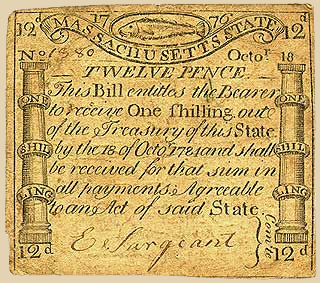
The primary reason that rebels create their own currency is that monetary control is far more of a force than people realize. Baron Rothschild was not being overly flamboyant when he said, “Give me control over a nation’s money supply, and I care not who makes its laws.” Being able to manipulate a money supply is a fantastic power, affecting every part of an economy. If you know in advance that the money supply will go up (diluting its value) or contract (concentrating its value), you immediately gain a massive advantage over everyone else – and you can target this advantage to help or hurt almost any group you choose.
Because of this, a rebel group that is tied to their opponent’s money has nearly lost before the battles begin. Serious rebels learn this quickly.
The rebellion that we’re all part of is not an armed rebellion, but a moral rebellion. And, interestingly enough, our rebellion understood very early on that money was a primary factor in our enslavement.
The roots of our rebellion go back as far as the first oppressed man or woman who thought clearly about morality, whenever that was. In modern times, however, we can trace our rebellion back to the 1940s – a time in which Mises had already been examining the foundations of money, Hayek was interested in competing currencies, and Rand was examining the morality of money.
(I’m passing over very many good people in the above paragraph. May they forgive my brevity.)
In our lifetimes, we’ve had David Chaum’s work on digital cash, Orlin Grabbe’s work (both theoretical and practical), e-gold, Pecunix, networks of exchangers, subsidiary services, and, most recently, crypto-currencies, beginning with Bitcoin. Our moral rebellion is not slowing down.
What matters about all of these currencies (and many more I haven’t mentioned) is that they are all rebel currencies. Sure, a few criminals and Ponzi operators have made use of our technologies, but that’s simply unavoidable. How many crooks use government money? (Answer: all of them.)
I think it’s important to make a few points about this moral rebellion of ours:
Our rebellion money has actually done a fine job of supporting these two moral points. The supposed failures of these currencies were primarily that they couldn’t withstand coercive and violent attacks. In other words, they worked very well; their “problems” were attacks from the status quo: a system of coercion and violence, masquerading as justice.
What we are now seeing is a moral awakening. Young people are questioning the systems that supposedly sustain them but actually use them as slaves.
When people begin to see the world in moral terms, they quickly perceive the deep immorality of the status quo – a system that is utterly dependent upon coercion and deception. If there is a root to the continuance and success of honest, rebel money, this is it.
In the end, our battle is this: morality versus coercion and deception.
Paul Rosenberg
FreemansPerspective.com
An article in a 1965 edition of Eagle, a British comic book, predicted the arrival of the Internet with stunning accuracy, including services similar to Skype, Netflix, Kindle and Google years before the very first rudimentary ARPANET links were even established and decades before the first incarnation of the world wide web became available to the general public.

